Bitcoin mining difficulty has fallen by 11% — the sharpest drop in five years — as winter storms, rising electricity prices, and declining profitability force miners to shut down operations.
Contents
2 min read
Bitcoin mining difficulty has recorded its sharpest decline in the past five years. The drop has become a warning signal for the industry, highlighting a dual crisis driven by extreme weather conditions and deteriorating mining economics.
Mining operators have faced major disruptions as winter storms combined with rising costs, putting additional strain on already thin margins.
Largest Network Adjustment Since 2021
Related: China Expands Crypto Ban, Outlaws Stablecoins and RWA Tokenization
According to Mononaut, a developer at the Mempool service, network difficulty fell by 11.16% this week to 125.86 trillion hashes. This marks the largest downward adjustment since July 2021, when China’s cryptocurrency ban triggered a mass shutdown of mining equipment and an exodus of miners.

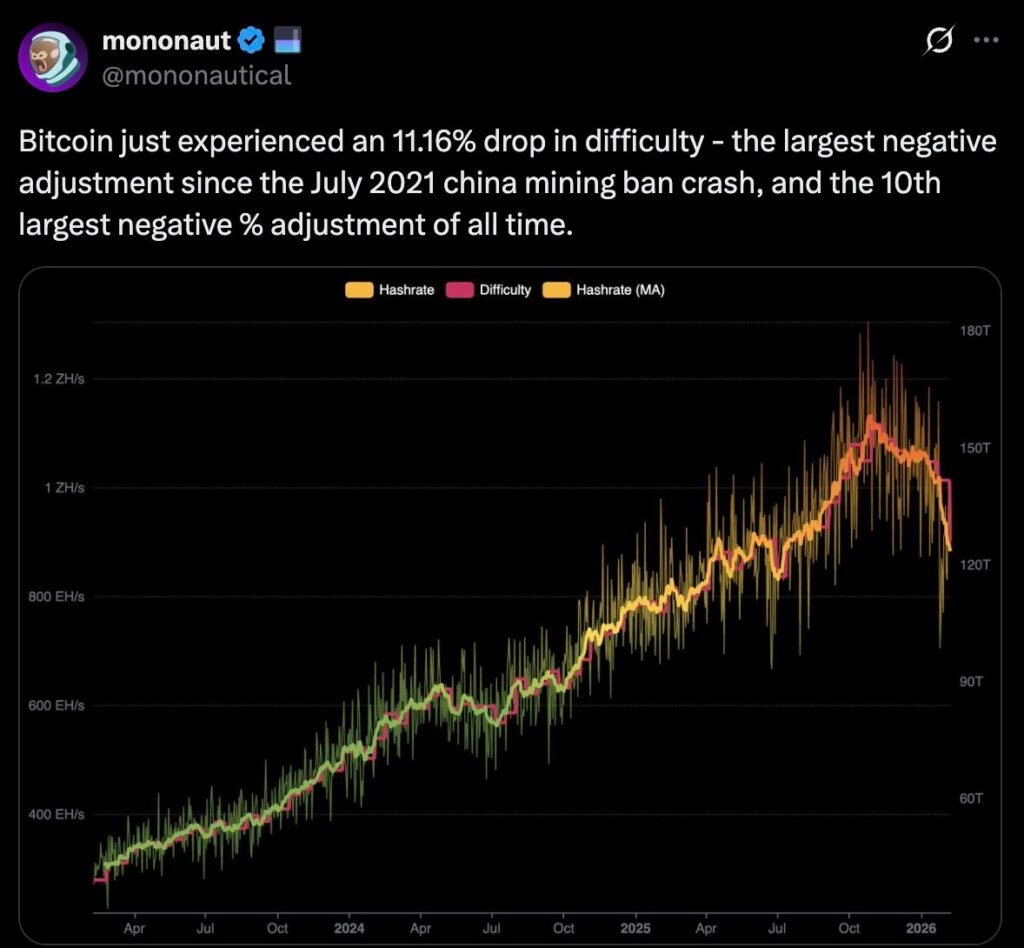
However, the current situation differs in nature. Instead of geopolitical shocks, the decline is being driven by a combination of climate-related disruptions and falling profitability.
Storms and Rising Electricity Prices
In late January, severe winter storms swept across North America, disrupting power grids that supply major mining hubs. In regions such as Texas, miners often participate in demand-response programs, voluntarily reducing electricity consumption during peak hours in exchange for energy credits.
Still, an 11% drop in hashrate suggests deeper structural issues beyond temporary shutdowns. A sharp increase in spot electricity prices has made operations unprofitable for miners running older, less energy-efficient equipment, forcing some facilities to partially or fully suspend operations.
Mining Profitability Under Threat
Financial pressure had already been building before the weather events. According to CryptoQuant CEO Ki Young Ju, Marathon Digital’s cost to mine one bitcoin stood at approximately $67,700 in the third quarter of 2025.
With Bitcoin trading below $70,000, many miners are now operating at a net loss even before accounting for administrative and overhead expenses. This raises serious concerns about the survival of less efficient mining companies.
The Bitcoin protocol is designed to maintain an average block time of 10 minutes. When computing power drops, block production slows, prompting the network to automatically reduce mining difficulty to rebalance conditions for remaining participants. The latest adjustment reflects the mounting pressure currently facing the mining industry.

Sophia is a pioneer in the world of Web3 and NFT ecosystems. With extensive experience in digital art and tokenomics, she breaks down the intricate relationships between creativity and blockchain technology. Her unique perspective bridges the gap between technology and culture.